

Overview
An EAF steelmaker wanted to cut costs in the melt shop without capex or major changes to the existing setup. Steel Hub applied its standard methodology: diagnose the whole process first, identify the best improvement opportunities, then optimise operating practices to deliver the savings.
Challenge
- An EAF steelmaker wanted to find high-saving improvement oppportunites in the melt shop with no capex and no majpor changes to the existing setup.
Key Takeaways
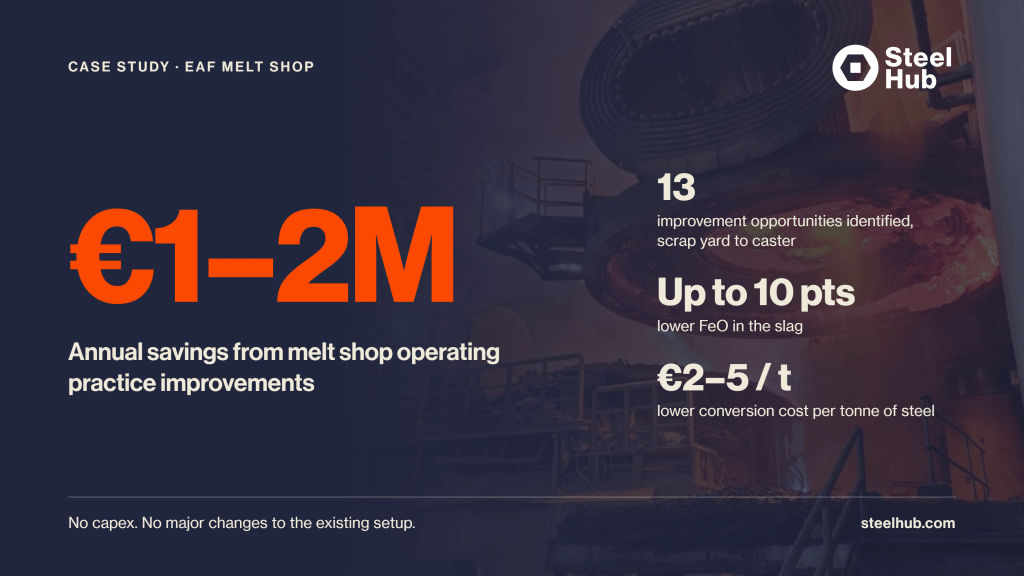
- Diagnosis – A full process assessment, from scrap yard to caster, identified 13 improvement opportunities.
- Solution – Slag engineering, bath deoxidation and an optimised carbon addition strategy to improve slag foaming.
- Impact – FeO in the slag fell by up to 10 points, conversion cost fell by €2-5 per tonne, and annual savings reached €1-2million.
Solution
- Full process diagnosis: An on-site assessment from scrap yard to caster, combined with analysis of historical process data, identified 13 improvement opportunities.
- Prioritisation: Each opportunity was ranked in an impact–effort matrix, separating the high-impact, low-effort “quick wins” from the rest.
- Opportunity taken forward: Metallic yield was the biggest saving lever. We applied slag engineering, bath de-oxidation and an optimised carbon addition strategy to improve slag foaming. This reduced FeO in the slag, cut wasted iron and protected the refractory lining.
- Validation: Every change was trialled in normal production and tracked heat by heat against a baseline.
Results
- Lower slag FeO: FeO in the slag fell by up to 10 points.
- Lower cost per tonne: Conversion cost fell by €2–5 per tonne of steel, with no penalty on tap-to-tap time or energy use.
- Final impact: Annual savings of €1–2 million.